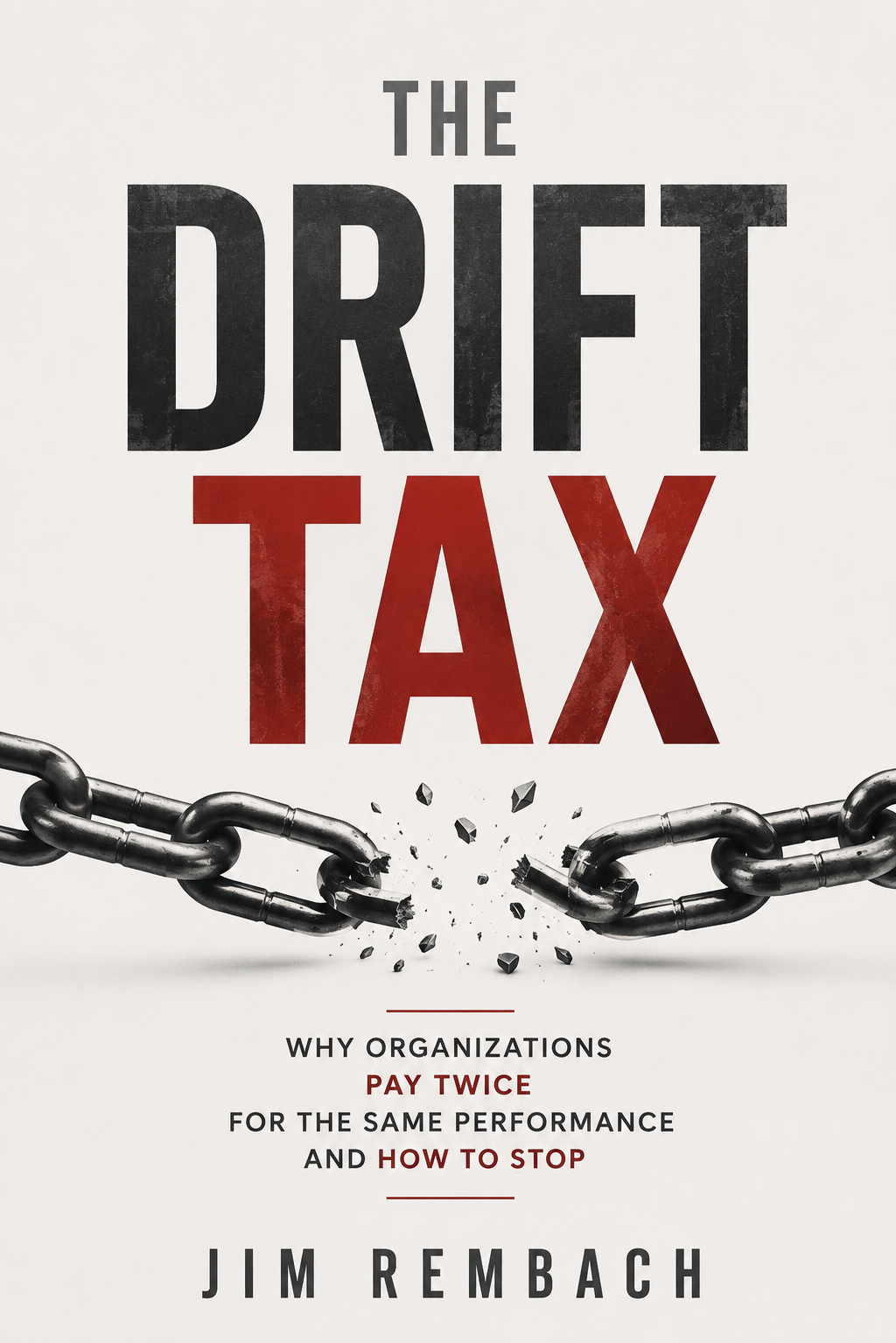
Coming Fall 2026

The Drift Tax

Why organizations pay twice for the same performance, and how to stop.

Get notified when the book is available.

The Drift Tax by Jim Rembach

About The Drift Tax

Why Organizations Pay Twice for the Same Performance, and How to Stop

Every organization pays for behavior when it hires: judgment, consistency, ownership, priced into the offer letter. That behavior has to travel the Kinetic Chain of Execution, from strategy to the frontline. But complexity has exceeded human capacity. The workload was rebuilt. The operating system underneath it was not. This is a pre-AI operating system running a post-AI workload, and under that gap, behavior drifts. Quietly. Continuously. The drift surfaces as symptoms that look unrelated, and those symptoms convert into hard financial variance long before anyone can name the cause.

Then the organization pays again, buying back stability it already funded, using remedies that ask the same overloaded people to carry the same load with newer vocabulary. Paid once at hire. Paid again at repair. The second payment is the tax, and it never arrives as a single line on the P&L. It distributes itself across everyone else's budget, filed under some other name.

This is not a skills book, and it is not a blame book. Drift is not a character flaw. The forces that pull behavior off standard are biological and environmental, running in every organization whether anyone is watching or not. The Drift Tax makes that second payment visible, so leaders can update their pre-AI operating system and reduce their tax burden.

Who it's for

Built for people who feel the second bill

If you have ever sat in a meeting where the numbers were real but no one could point to a single decision that explained them, this book is for you.

  • CFOs and finance leaders who spend more time on transformations than capital, and can't yet name what keeps them from sticking
  • Operators and executives who keep authorizing the same fix for a problem that already had a name
  • Executives watching every dashboard glow green while margin compresses anyway, with no decision anyone can point to
  • Leaders who are challenged by intent not converting to execution

Takeaways

Things This Book Will Teach You

Instruments, not advice: ways of seeing the Drift Tax that, once acquired, you will not be able to switch off.

  1. 01How to see the cost of drift that has been invisible your entire career, and where it is hiding in your own budget lines
  2. 02Why the forces that pull behavior off standard are biological and environmental, not failures of character or competence
  3. 03The Kinetic Chain of Execution: how strategy, structure, management, and the frontline must transfer energy, and where the leak usually is
  4. 04Receipt Logic: the one question that reveals whether you already paid for the capability you are about to buy again
  5. 05Why training, coaching, and platforms, sincere and expensive as they are, stop exactly one step short of creating momentum
  6. 06How a single hiring decision becomes a mortgage on behavior, and what is (and isn't) securing it
  7. 07How drift travels from an eleven-second moment to a line item finance calls something else
  8. 08What organizations that stopped paying the tax built instead, and what that kind of solution has to do

From the author

Let Me Tell You About The Book…

I wrote this book because I kept meeting Dana. She is a composite of executives I have sat across from for years: the CFO who ran the numbers three times before the board meeting because revenue landed on plan, headcount matched the model, every dashboard glowed green, and margin compressed anyway. Nothing broke. Nobody failed. And nobody in the room could say what changed.

I spent years as a baseball pitching coach before I built a career in the contact center world, and coaching pitchers taught me something no business book ever did. A 95-mile-per-hour fastball does not come from the arm. It comes from a kinetic chain: legs to hips to torso to fingertips. When one link fires out of order, velocity dies. Every organization has the same physics. I call it the Kinetic Chain of Execution: strategy as the legs, structure as the hips, management as the torso, and the frontline as the fingertips. Executives keep trying to throw harder with the arm. The energy is leaking upstream, in the transfer. Once I saw that chain, I could not stop seeing it, from contact centers to executive boardrooms.

For hundreds of episodes of my podcast, the Fast Leader Show, I interviewed the people who built the frameworks the leadership industry runs on, and I kept hearing the same uncomfortable pattern: every one of them knew what good leadership looks like. The knowledge was never missing. What is missing is an operating system that keeps the Kinetic Chain of Execution intact under load, so intent converts to execution instead of leaking into the Drift Tax. This book is about that chain, that tax, and what it costs you not to fix either.

About the author

Jim Rembach

He is the Executive Director of the Leadership Execution Institute, and host of The Fast Leader Show podcast.

His point of view was shaped in operations, not theory. He began as a frontline supervisor and later led multi-site operations, where he repeatedly saw the same failure pattern: organizations invest heavily in hiring, training, coaching, and tools, yet execution degrades once real work begins. Standards slip. Priorities drift. The same solved problems return. Leaders are capable, but the system they operate inside does not protect execution reliability.

That is the economic problem this book names. When execution depends on memory, interpretation, and individual willpower, organizations absorb a hidden liability and pay again for performance they thought they already funded. The Drift Tax makes that cost visible, and shows what it takes to stop approving it. And in this more complex world, the tax is growing.

Stay in the loop

Get notified when the book is available

Join the waitlist so you hear first when The Drift Tax launches.

Notify me